
Forest Condition Survey
The Forest Condition Survey (Waldzustandserhebung, WZE) is a terrestrial sampling method. For over 30 years, data on the crown condition of the most important tree species has been collected and evaluated annually and uniformly throughout Germany. The observed needle/leaf loss (NBV) serves as an indicator of the vitality of individual trees. Further damage assessment provides information about the causes and extent of vitality loss. The proportion of damage at the state level can be determined across the entire sample size. The methodological foundations of the WZE can be found under Level I Methods.
The nationwide survey is conducted on the 16 x 16 km grid (Level I grid), as is the European forest condition survey. In Brandenburg, the WZE was shifted to the sampling grid of the National Forest Inventory (BWI) in 2009. Since 2021, the surveys have been conducted again on the 8 x 8 km grid.
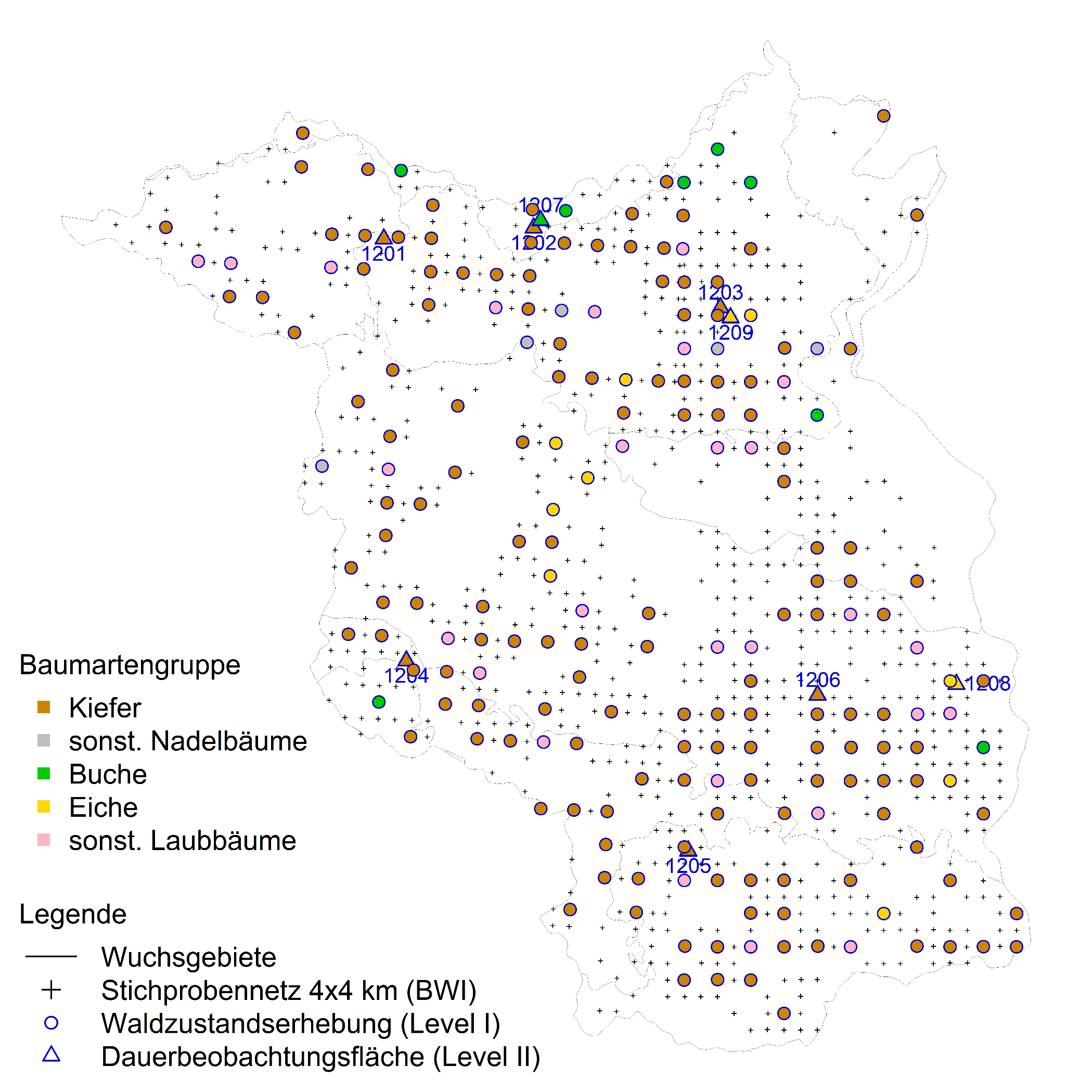
At the state level, Brandenburg and Berlin cooperate on forest environmental monitoring. The current Forest Condition Report for Brandenburg and Forest Condition Report for Berlin document the vitality development of pine-dominated forests and the main deciduous tree species oak and beech found here. At the federal and European level, the WZE is evaluated on the 16 x 16 km grid.